
Skunk Smell Removal: What Actually Works
Skunk smell removal that works: the peroxide, baking soda and dish soap mix neutralizes the spray.
Your reading path 9 stops

Skunk smell removal is a chemistry problem, not a cleaning problem. The smell is not a stain, and shampoo will not wash it out. Skunk spray is a yellow-tinted oily liquid full of sulfur compounds called thiols, and soap and water leave most of them in place. What works is a fresh mix of 3 percent hydrogen peroxide, baking soda, and liquid dish soap, applied to the source quickly.
Everything else you have heard about skunk smell removal is either a partial fix or a myth. Tomato juice does not neutralize it, and once the oil has soaked into a deck board or a car seat, repeated treatments may be needed and sometimes the only fix is removing the material.
The chemistry behind skunk smell removal#
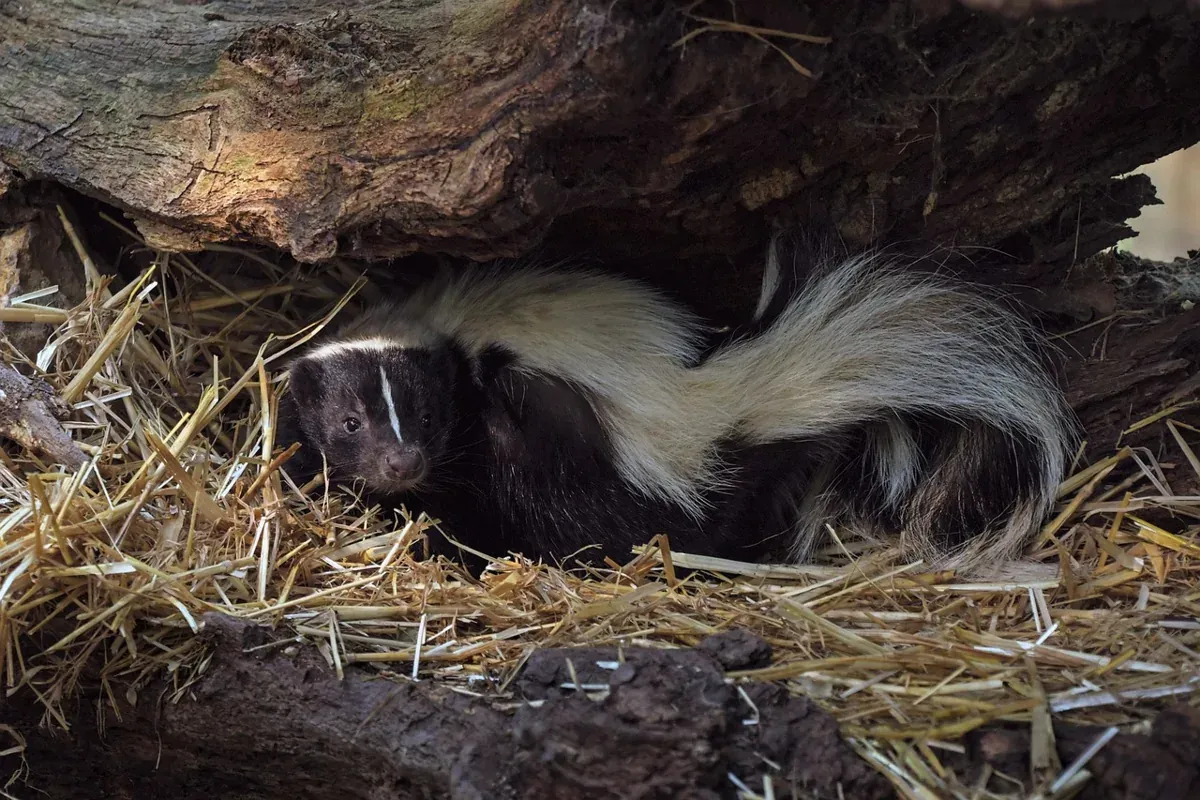
Skunk spray is a blend of sulfur compounds called thiols, and the peroxide mix works because it oxidizes them into odorless compounds that rinse away with water.
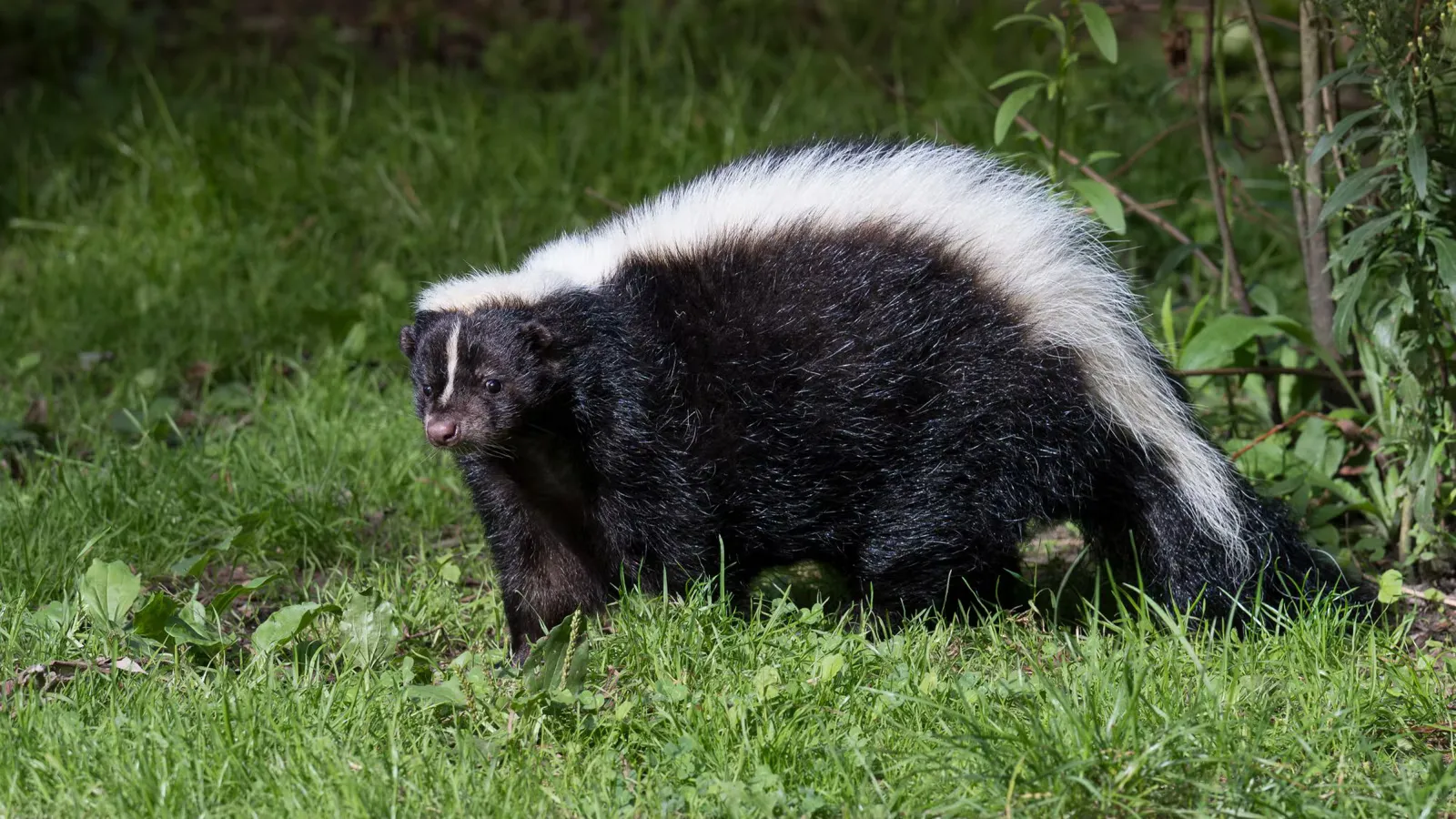 Striped skunk with a thick white tail arched over its back on grass
The fallout for skunk smell removal is practical. Thiols are not water-soluble even with soap, so a plain bath mostly spreads the oil around. Fresh spray also holds thioacetates, which barely smell at first and turn into thiols when wet, which is why a sprayed dog smells skunky again after a bath or a wet walk.
The mix that actually works#
This is the formula a chemist named Paul Krebaum worked out, and what extension services still publish for skunk smell removal:
- 1 quart of 3 percent hydrogen peroxide, from a fresh bottle
- 1/4 cup of baking soda
- 1 to 2 teaspoons of liquid dish soap
Mix it in an open container and use it immediately. Never seal it in a bottle, because the oxygen released as it reacts can make it burst.
For a person or a pet, wear rubber gloves, work the mix through the fur down to the skin, leave it about five minutes, then rinse. Repeat if needed. For clothing, do not pour it on directly. Add it to the wash cycle instead so it gets diluted.
Where the mix stops working#
- It bleaches. Peroxide lightens a black dog's coat to a bronze color and can bleach fabric, so test a hidden patch first.
- It stays away from the face. Keep it out of the eyes and mouth.
- It cannot reach deep into porous material.
Tomato juice is a myth#
Every fall someone recommends a tomato juice bath for skunk smell removal. It does not work, and the Nebraska extension guide says so plainly: tomato juice is ineffective at neutralizing skunk odor.
What happens instead is a trick of the nose. The smell is so overwhelming that your sense of smell temporarily stops registering it, a condition called olfactory fatigue, so the tomato simply reads as something new.
Mothballs and ammonia scattered in the yard are not proven to repel skunks, they are dangerous, and using them in the landscape violates federal regulations. Predator-urine products are unnecessary and inhumane to produce.
Surfaces: what to do where#
Skunk smell removal on surfaces follows the same order every time: remove the source, ventilate, wash the surface, then handle what is left in the air.
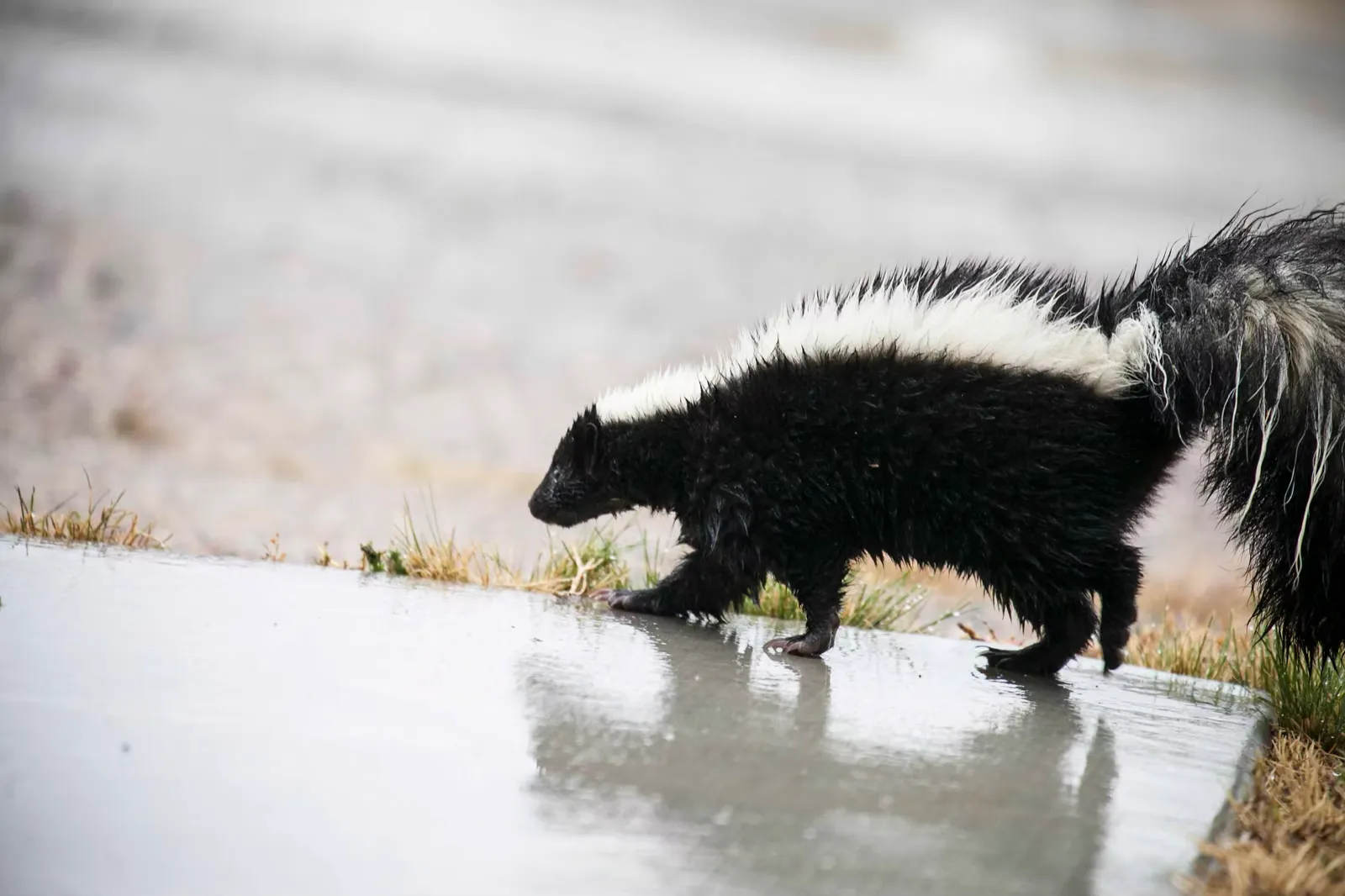 Striped skunk walking along the edge of a wet concrete slab
Photo: USFWS Mountain-Prairie, Wikimedia Commons, Public domain
| Surface | What to do | What to watch for |
|---|---|---|
| Laundry and bedding | Wash with detergent, add the mix to the wash cycle, wash twice, hang dry outdoors | No dryer; undiluted mix can discolor fabric |
| Deck and concrete | 1 cup of bleach in 1 gallon of water, on the spray spot only | Bleach may stain wood; never mix it with the peroxide solution |
| House interior | Ventilate, wash hard surfaces, replace the furnace or AC filter if it took on the odor | Odor returns on humid days until the source is gone |
| Car | Ventilate, wash hard surfaces, treat fabric as a porous surface | Foam and padding may need repeated treatments or replacement |
Inside the house, a filter that took on skunk odor has to be replaced rather than cleaned, and odor that returns on humid days is expected. If it gets stronger after a week or two, a skunk may be living or dead on the property.
No guide has a car chapter, but the porous-surface rule covers it: sheetrock, concrete, and unpainted wood may need several treatments, and sometimes the only fix is removing the material. Carpet and foam behave the same way, and anything that cannot be washed is best hung outside.
If your dog was sprayed in the face#
Seek veterinary care right away if a dog is sprayed directly in the eyes or mouth. Cornell's veterinary hospital lists the damage: swelling and redness of the eye, cornea damage, temporary blindness, respiratory irritation, and nausea, drooling, and vomiting if the spray reaches the mouth.
Then watch the dog for 1 to 3 days. Rarely, hours to a day after a heavy spray, multiple exposures, or ingestion, a serious anemia develops, signaled by gums that turn a chocolate color. It needs IV fluids and possibly a transfusion.
Rabies is a separate question. Skunk spray cannot transmit rabies, but skunks are one of the four main rabies carriers, along with foxes, raccoons, and bats, so the risk is a bite. Keep vaccinations current and call a vet after any bite.
Wash the pet outdoors, because the oils transfer to fabric. If the solution gets into eyes, flush with clean water for 15 minutes.
Keeping skunks off the property#
Grubs. Skunks dig shallow, cone-shaped holes while hunting insect larvae. Killing the insects before digging starts is the move that helps, since treatment rarely stops an animal already at work. Wet soil pushes grubs up, so a dug-up lawn can also mean an overwatered yard.
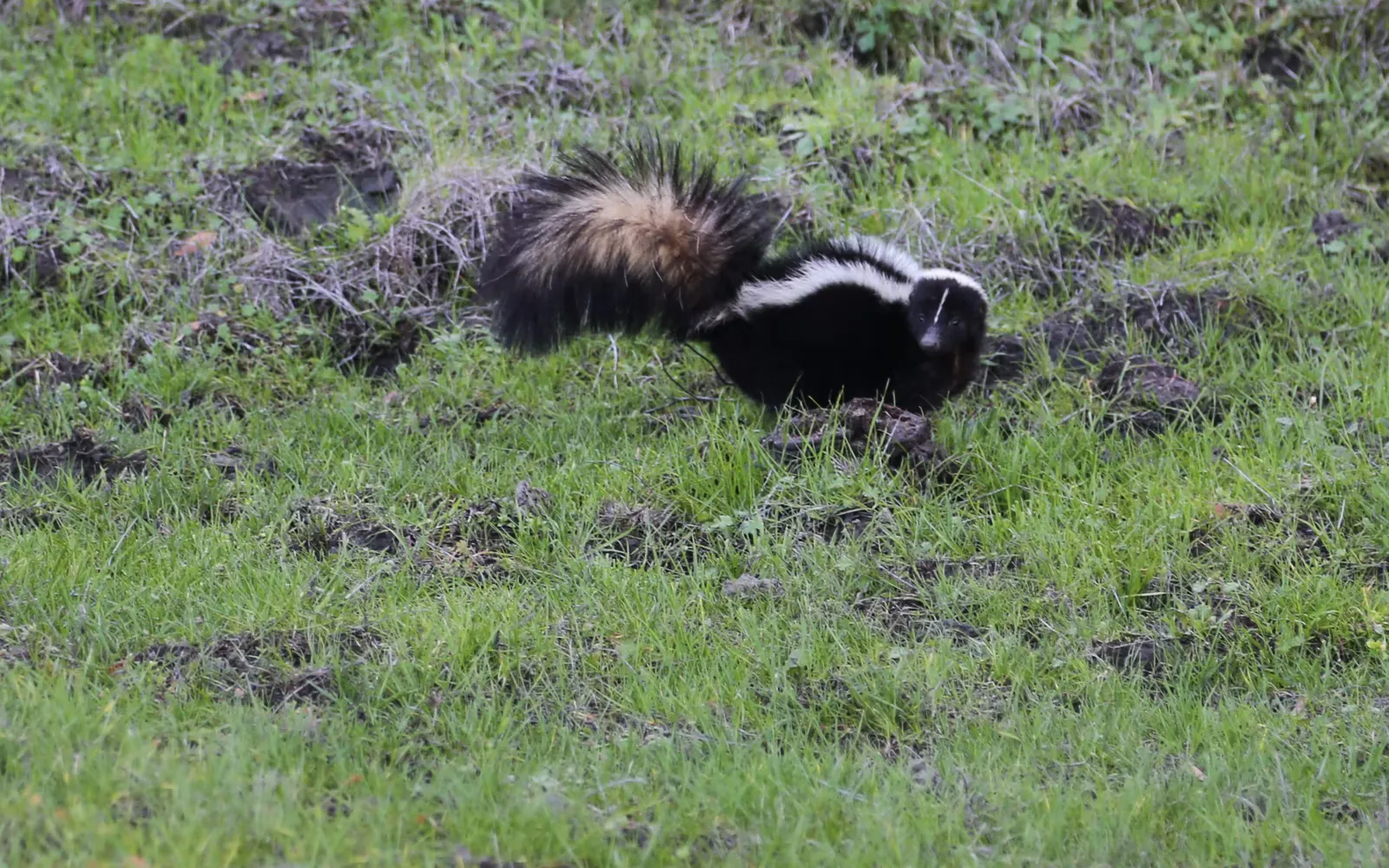 Striped skunk crouching in a lawn pocked with small dug holes
Photo: Dcrjsr, Wikimedia Commons, CC BY 4.0
Garbage and pet food. Secure the bins, feed pets indoors or pull the bowl right after the meal, and lock up birdseed. Remove brush piles and stacked lumber, and cover window wells.
Denning under decks and sheds. Burrow entrances are 3 to 5 inches across with little or no grass around them, usually under stumps, decks, or lumber piles. A den does not necessarily smell skunky, since a healthy skunk does not spray unless provoked. Test an entrance by plugging it loosely with soil, leaves, or crumpled paper; if the plug is pushed out overnight, something is home. Once it is empty, close the opening with 1/2-inch galvanized hardware cloth, buried 2 to 3 inches and bent 12 inches outward. Do not seal a den between April and August without checking first, since young may still be inside.
Light and noise can make a denning site unattractive, and a one-way door works once the young are mobile. Traps and relocation are regulated, and a trapped skunk generally may not be released elsewhere because of rabies risk. Check your own state wildlife agency first.
For lasting skunk smell removal, the honest answer most of the time is to leave the animal alone. Skunks are docile, they eat insects and rodents, and Nebraska's guide notes that killing them indiscriminately is not appropriate when only a small share carry rabies. For the animal itself see the striped skunk; for the evidence it leaves, our guide to skunk droppings covers size and placement, and the humane removal guide for skunks covers exclusion.
FAQ#
Does tomato juice really remove skunk smell? No, it is a myth. Tomato juice does not neutralize the thiols, and the improvement people report is olfactory fatigue, not chemistry.
Can I mix the peroxide solution ahead of time? No. Mix it in an open container and use it immediately; never mix it in advance. A sealed bottle can burst as it reacts.
Will the mix bleach my dog? It can. Peroxide lightens dark fur toward bronze and can bleach fabric, so test a small hidden patch first.
How long does skunk smell removal take? Typically several weeks, and it can seem to return on humid days. If it holds steady or gets stronger, look for a skunk living in or under a structure, or one that died there.
Can skunk spray give my dog rabies? No. Rabies comes from a bite, not spray. Skunks are still a major carrier, so keep vaccinations current and call a vet after any bite.
Sources#
- University of Nebraska-Lincoln Extension. Removing Skunk Odor, NebGuide G2100. Accessed 17 November 2026.
- University of Nebraska-Lincoln Extension. Dealing With Skunks, NebGuide G1769. Accessed 17 November 2026.
- Cornell University College of Veterinary Medicine, Riney Canine Health Center. What to do when your dog gets skunked. Accessed 17 November 2026.
- Humane World for Animals. What to do about skunks. Accessed 17 November 2026.
You made it to the end!
Still not sure who visited? Bobr's sign finder narrows it down in a few taps.
A 3-part series
The Skunk series, chapter by chapter
- Chapter 1
What Do Skunks Eat? Diet, Lawn Grubs and Garbage
Skunks eat mostly insects, and the grubs under your lawn explain the holes. Here is the diet season by season, and what to put away tonight.
Coming soon · December 4✓ Read - Chapter 2
Skunk Smell Removal: What Actually Works
Skunk smell removal that works: the peroxide, baking soda and dish soap mix neutralizes the spray.
You're reading this✓ Read - Chapter 3
Do Skunks Hibernate? What They Do in Winter
Do skunks hibernate? No: a striped skunk dens up, sleeps in bouts and lives on stored fat, and several may share one den under a deck. Late winter is when the smell starts.
Coming soon · December 15✓ Read
1 of 3 chapters are out; new ones appear here as they publish.
Animals in this article
Keep reading
How to Get Rid of Woodpeckers Without Breaking the Law
How to get rid of woodpeckers without breaking the law: why they drum on siding and gutters, plus the legal fixes that stop the damage for good.
Moles in Yard: Signs, Damage and How to Stop Them
Moles in yard soil leave volcano mounds and raised ridges.
Do Opossums Carry Rabies? What the Evidence Says
Do opossums carry rabies? Rarely, and the animals are not immune.
No comments yet. Seen this in your own yard? Start the thread.
Leave a comment