
Moles in Yard: Signs, Damage and How to Stop Them
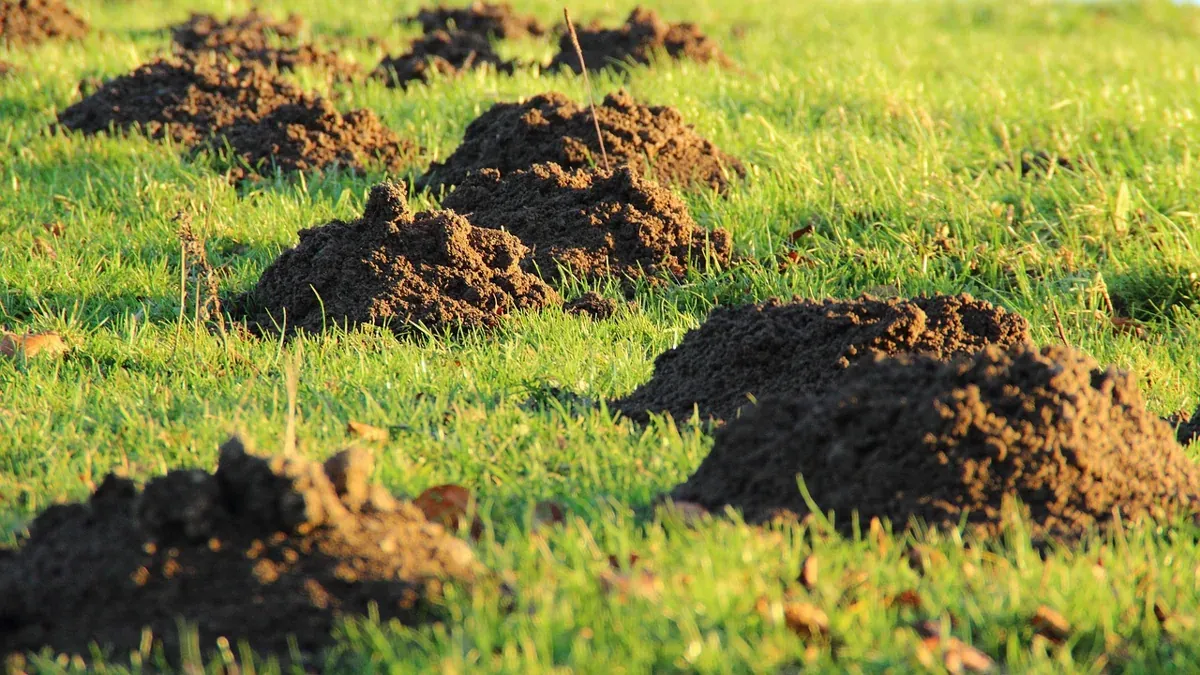
Moles in yard soil leave volcano mounds and raised ridges.
Your reading path 10 stops

Short answer: those volcano-shaped mounds and raised, winding ridges are almost certainly moles, not voles. Moles in yards and gardens leave both, and the two signs point to two different tunnel types: the mounds come from deep tunnels, the ridges from shallow feeding runs. The animal behind both eats earthworms and insects rather than your plants.
The rest is less popular. Moles are solitary, a normal city lot rarely holds more than one or two, and trapping is the one method that consistently works. Most of what is sold as mole control does nothing, and some methods are illegal.
Moles in Yard: What the Mounds and Ridges Tell You#
A mole builds two kinds of tunnel, and the damage tells you which.
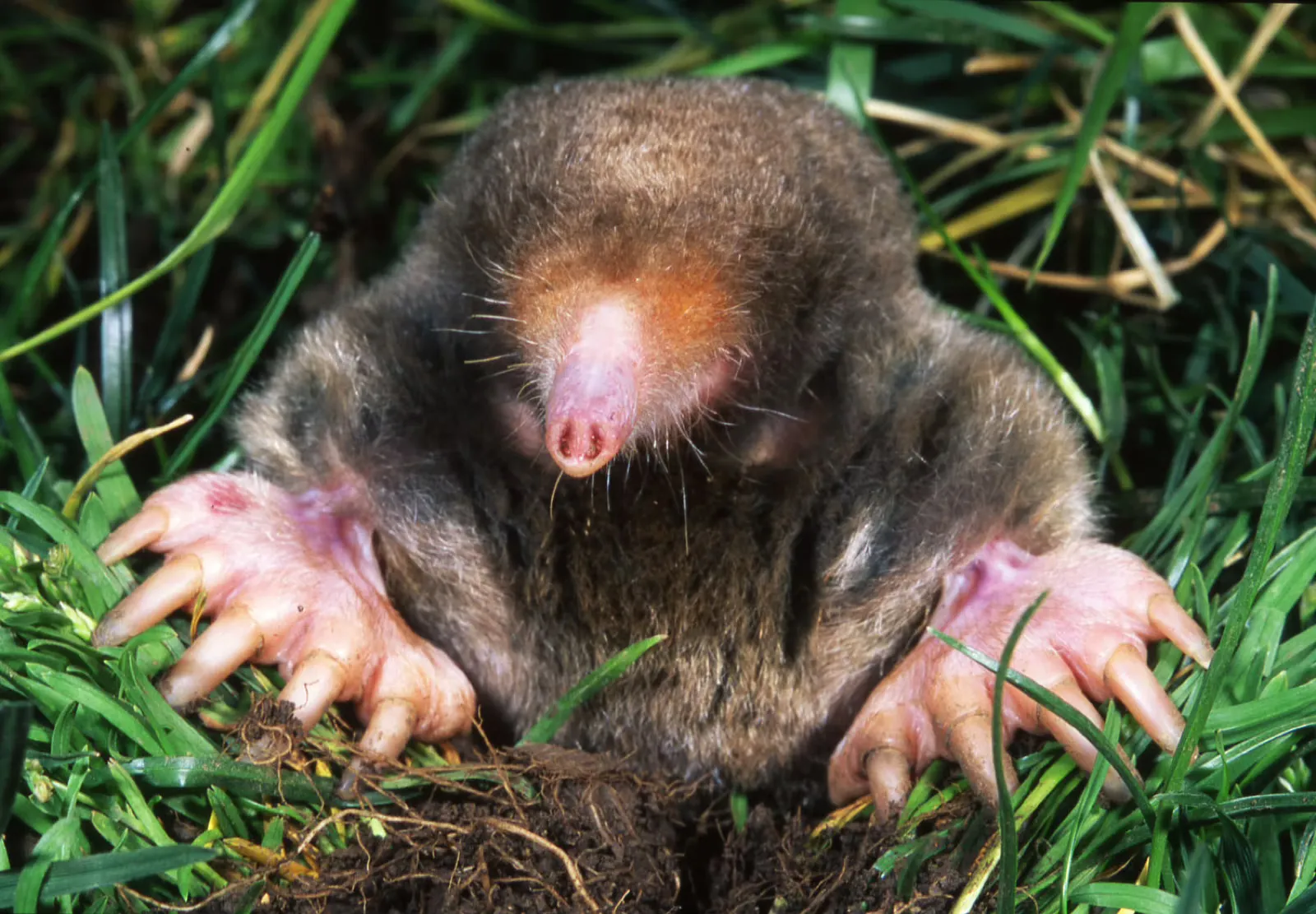 Eastern mole pushing out of a tunnel in grass with wide pink front paws
Photo: Kenneth Catania, Vanderbilt University, Wikimedia Commons, CC BY-SA 3.0
Volcano mounds are soil pushed up from the deep runways, the passages between nest and hunting grounds. The pile is roughly circular, 6 to 24 inches across and 2 to 8 inches high, with the entrance near the center always plugged. The number of mounds does not tell you how many moles you have.
Raised ridges are shallow surface tunnels, 1 to 4 inches down, showing as bands about 3 inches wide that you can often feel underfoot. Deep runways sit 3 to 12 inches down and can reach 40 inches.
Moles dig about 15 feet per hour, and digging peaks in fall and winter, when soil is wet.
Moles in Yard or Voles?#
This is the check most homeowners get wrong.
| Sign | Mole | Vole | Pocket gopher |
|---|---|---|---|
| Mound shape | Volcano, 2 to 8 inches high, entrance plugged | No mounds, only surface runways and burrow openings | Kidney-shaped, finely sifted soil, often in a line |
| Surface damage | Raised ridges you can step on | Runways 1 to 2 inches wide, grass clipped short | Mounds larger than a mole's, in lines or clusters |
Voles cut runways 1 to 2 inches wide with grass clipped close to the ground, and they girdle trees and eat roots. Their gnaw marks on trees are irregular, about 1/8 inch wide and 3/8 inch long, while rabbits clip branches at a clean 45-degree angle. Pocket gopher mounds are kidney-shaped and usually in a line.
For the two you are most likely to mix up, our moles vs voles comparison goes sign by sign.
What moles actually eat#
Diet reframes the problem. Moles in yard soil eat insects, grubs and worms, plus snails, slugs, ants and beetles. In Oregon stomach samples, 70 to 90 percent of the Townsend's mole diet was earthworms. Plant material is taken by accident, mostly when nothing else is available.
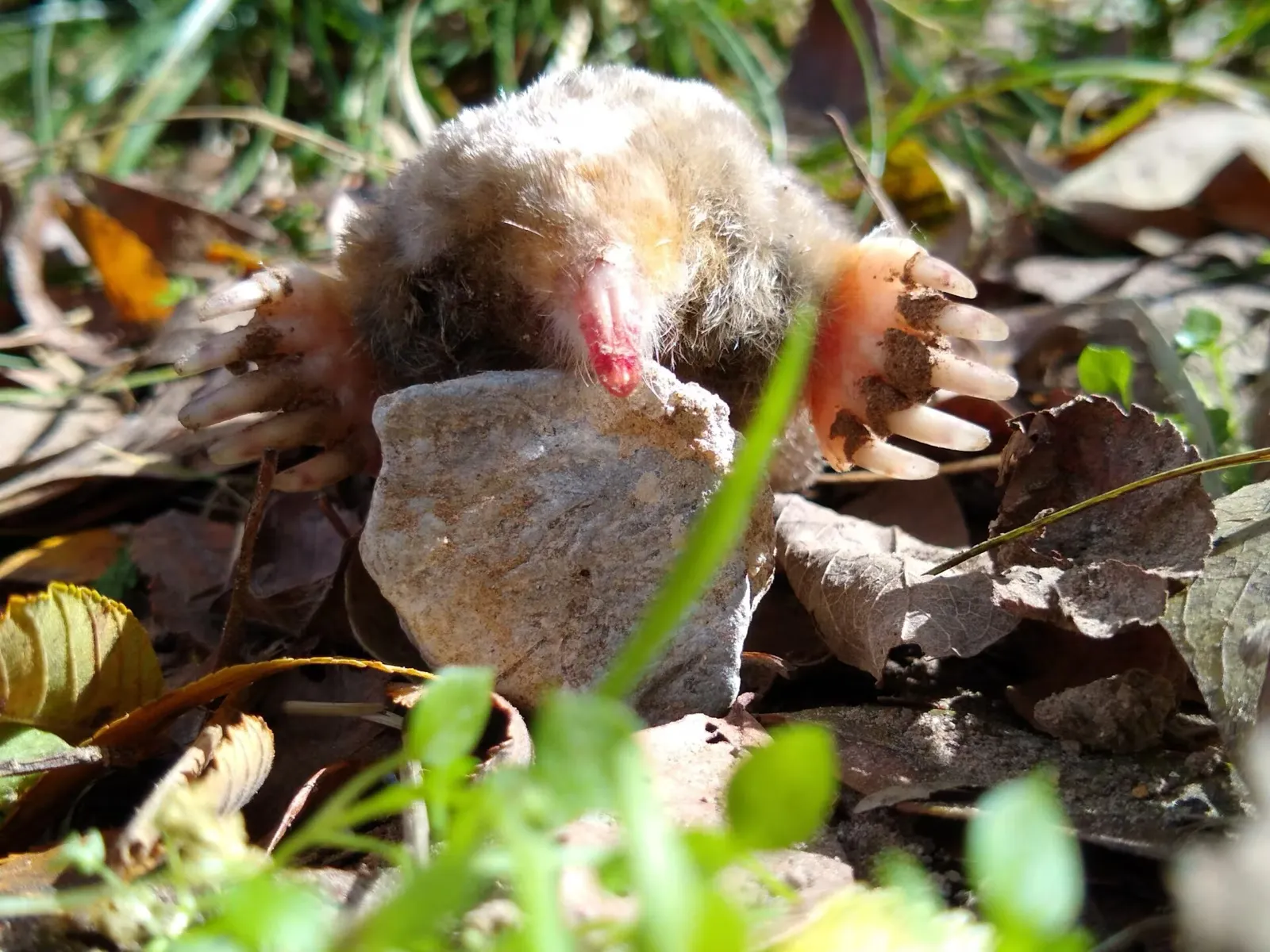 Eastern mole nosing over a stone in leaf litter while searching for worms
Photo: L. K. Holt, Wikimedia Commons, CC BY 4.0
They eat 70 to 100 percent of their body weight a day.
So starving them out does not hold up. A lawn can be free of grubs and still have moles, because worms and ants are on the menu and moles visit watered lawns for moisture. Cutting soil insects can make a mole dig harder, not less, and soil insecticides are an expensive approach with no immediate reduction in damage, and they may reach groundwater.
The damage is mostly cosmetic#
Most garden damage blamed on moles is caused by rodents using mole tunnels to reach roots. Moles heave small plants out of the ground, cover seedlings, and separate turf roots from soil. No diseases are known to pass from moles to people. The same digging aerates soil and removes cranefly larvae and slugs.
Moles in Yard: Why the Home Remedies Fail#
Wildlife agencies and extension services have tested folk fixes, and the failures are consistent. Chewing gum, rose thorns, broken glass, used cat litter, gasoline and ammonia have all proven ineffective, and several are hazardous. Mothballs, garlic, spearmint leaves and a perimeter of so-called mole plants give mixed results at best. Razor blades, barbed wire and thorned canes are more dangerous to the gardener than to the mole, and a mole often just seals a blocked tunnel and digs again.
Frightening devices fare no better: vibrating stakes, ultrasonic units, magnetic gadgets and pinwheels are unproven, partly because moles live among vibrations from sprinklers and mowers.
Castor oil products show minor effectiveness, but only when watered in, and heavy irrigation leaches them away. That is why remedies appear to work against moles in yards: a mole works one part of its tunnel system for a few days, then shifts, sometimes next door, and the treatment gets credit for the gap.
Poisons, gas and the law#
Grain-based bait is a poor fit for an animal that eats worms, and moles push it back to the surface. The two mole baits come as a gel squirted into a run and a synthetic worm.
Fumigants are where legal trouble starts. Aluminum phosphide is a Restricted Use Pesticide needing a Fumigant Management Plan, and smoke cartridges are registered in most states with restrictions. Gas is unreliable anyway: moles seal the burrow within seconds, and it moves poorly through dry soil. The label is the law.
Wildlife rules can only get stricter from federal to state to local level. In Washington, moles are unclassified and a person may trap or kill them on their own property when they damage crops or property. But Initiative 713 made traditionally used body-gripping mole traps illegal there, with no emergency exception and no permit to work around it. Rules differ from state to state and province to province, so a method that is legal next door may be banned at home. Call your state or provincial wildlife agency, then your municipality.
Moles in Yard: Trapping Is the Method That Works#
Trapping is the most successful and practical way to control moles, and each style works when set correctly: the harpoon drives spikes through the run, the scissor jaw closes across it, the choker loop tightens around the mole.
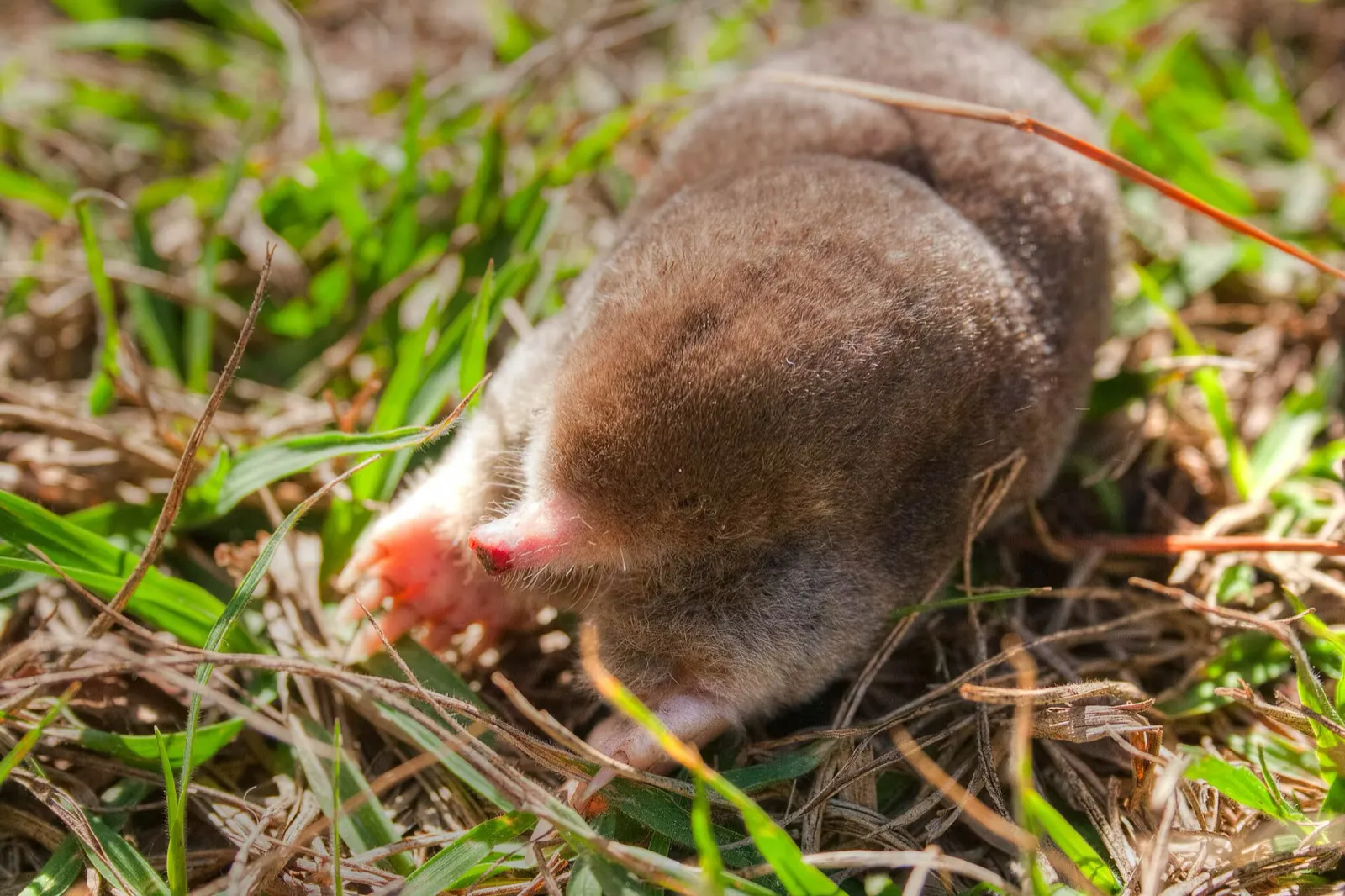 Eastern mole walking across short grass with one pink front paw lifted
Photo: Bert Cash, Wikimedia Commons, CC BY 2.0
Set the trap on a straight stretch of surface runway with fresh activity, never on a mound or a twisting ridge. Depress the tunnel under the trigger so it sits squarely, cover the trap with a bucket, and mark it with a flag. No catch after two or three days means move it.
Timing matters for humane reasons. Moles produce one litter of three to five young after a gestation of about 42 days, so late winter and early spring is the window before that. Trapping is lethal, so the set has to be quick and checked often. Maximum lifespan is four to six years, so removal is not permanent while good habitat remains. If you will not do the killing, hire a licensed operator. Our guide to getting rid of moles covers that choice, the mole profile has tracks and body details, and the sign finder matches holes, droppings and tracks.
Exclusion and cheap fixes#
Barriers suit a seed bed, not a whole lawn: 24-inch sheet metal or hardware cloth at the surface, buried a foot deep, top bent out at 90 degrees. It is laborious and costly, so save it for exceptional cases.
Cheap fixes help the look of the yard. Flatten ridges, rake out mounds before mowing, fill the depressions with sand or screened dirt and reseed, reposition heaved plants, and let the lawn run a little longer.
Moles in Yard FAQ#
Is it moles or voles in my yard? Mounds and ridges mean moles. Narrow clipped runways at the surface mean voles. Both can share a yard, since voles use mole tunnels.
Do moles eat plants? Almost never on purpose. The diet is earthworms, grubs and insects. If bulbs and roots are vanishing, suspect voles.
Will killing the grubs get rid of moles? Probably not. Grubs are only part of the diet, and moles visit watered lawns for moisture.
Can I use poison? Not casually. Some products are Restricted Use pesticides, fumigants are unreliable, and state or local rules can forbid the method. Ask your wildlife agency.
Sources#
- Internet Center for Wildlife Damage Management. Mole Damage Identification. Accessed 17 November 2026.
- Internet Center for Wildlife Damage Management. Mole Biology. Accessed 17 November 2026.
- Internet Center for Wildlife Damage Management. Mole Damage Prevention and Control Methods. Accessed 17 November 2026.
- Internet Center for Wildlife Damage Management. Vole Damage. Accessed 17 November 2026.
- Internet Center for Wildlife Damage Management. Legal Issues. Accessed 17 November 2026.
- Washington Department of Fish and Wildlife. Living with wildlife: Moles. Accessed 17 November 2026.
You made it to the end!
Still not sure who visited? Bobr's sign finder narrows it down in a few taps.
Animals in this article
Keep reading
Skunk Smell Removal: What Actually Works
Skunk smell removal that works: the peroxide, baking soda and dish soap mix neutralizes the spray.

How to Get Rid of Woodpeckers Without Breaking the Law
How to get rid of woodpeckers without breaking the law: why they drum on siding and gutters, plus the legal fixes that stop the damage for good.
Do Opossums Carry Rabies? What the Evidence Says
Do opossums carry rabies? Rarely, and the animals are not immune.
No comments yet. Seen this in your own yard? Start the thread.
Leave a comment