
How to Get Rid of Woodpeckers Without Breaking the Law
How to get rid of woodpeckers without breaking the law: why they drum on siding and gutters, plus the legal fixes that stop the damage for good.
Your reading path 7 stops

The short answer to how to get rid of woodpeckers is that, in the United States, you cannot trap, shoot, poison, or tear out an active nest. Almost every woodpecker is protected by the Migratory Bird Treaty Act, and "take" under that law covers killing and capturing as well as selling, trading, and transport.
What works is making the building unappealing: netting over the siding, filled holes, an end to the insect infestation under the wood, and work timed around nesting season. None of that needs a permit.
The law comes before any tool#
The Migratory Bird Treaty Act of 1918 implements treaties with Canada, Mexico, Japan, and Russia, and it prohibits taking a protected migratory bird without prior authorization from the U.S. Fish and Wildlife Service. The agency confirms that woodpeckers are covered, along with their nests and eggs, and that protection does not depend on whether a bird migrates.
A permit exists, but it is narrow. Depredation permits are issued only when nonlethal methods have been tried and failed and the applicant can show strong justification, such as significant structural damage that has caused an economic hardship. UC IPM adds that woodpeckers other than endangered species can be killed only under a permit from the Fish and Wildlife Service Law Enforcement Division, on the recommendation of USDA-APHIS Wildlife Services, and that the process is time consuming.
State rules can add more: UC IPM notes that two California woodpeckers, the Gila woodpecker and the gilded flicker, are state listed as endangered and cannot be harassed at all.
If you want a single test for how to get rid of woodpeckers without a permit, use this: anything that does not harm the bird or disturb an active nest is allowed.
Why it is drumming on your gutter in the early morning#
Drumming is not feeding. It is rhythmic tapping used to proclaim breeding territory and social standing, and woodpeckers choose surfaces that carry, often skipping wood entirely for metal gutters, downspouts, chimney caps, and rooftop ventilators. Both sexes drum. The Fish and Wildlife Service says drumming for territory or social reasons will most likely happen in early spring, at the start of the breeding season, and notes that woodpeckers have been seen banging on street signs to amplify the sound.
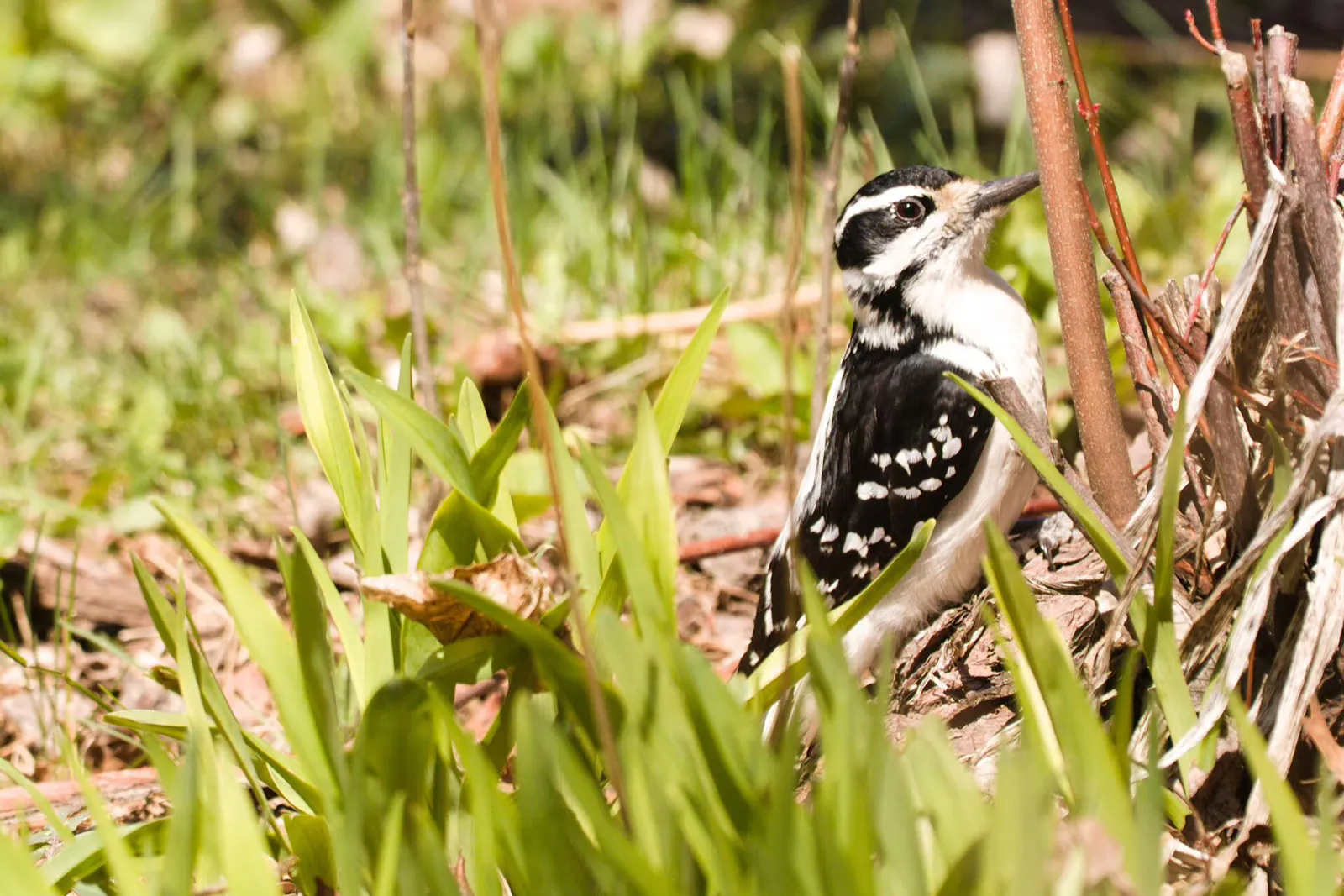 Hairy woodpecker gripping a thin tree trunk beside bright spring foliage
Photo: Mathieu Landretti, Wikimedia Commons, CC BY-SA 4.0
So the metal is the point, and the noise fades with the season. That racket is what sends most people looking for how to get rid of woodpeckers, so it helps to know that it stops on its own.
Why it is drilling holes#
When a woodpecker is cutting rather than drumming, it is eating, nesting, or storing.
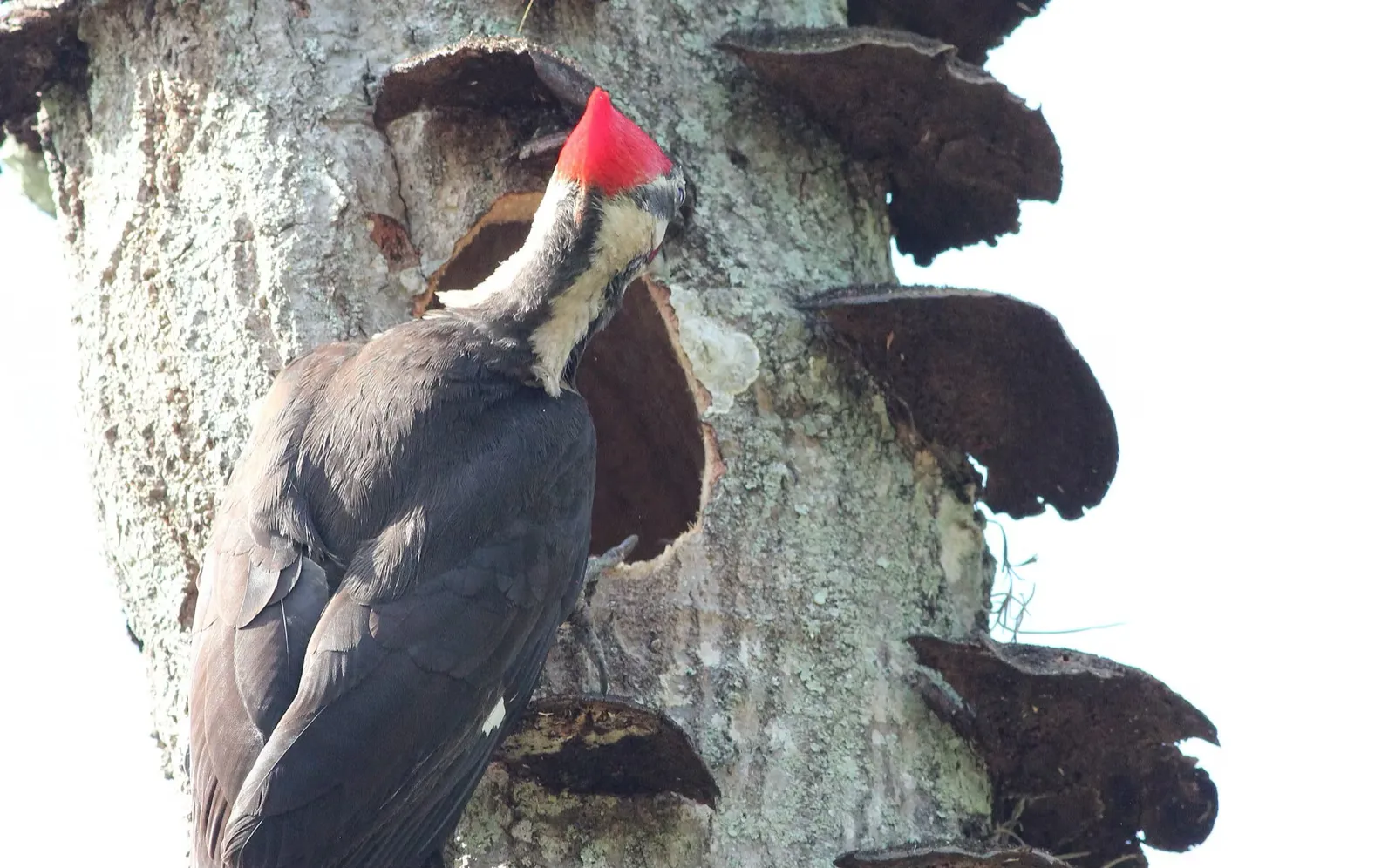 Pileated woodpecker beside a large rectangular hole cut in a dead trunk
Photo: gary_leavens, Wikimedia Commons, CC BY-SA 2.0
- Eating. Inspect the siding for insect damage first, because the bird is often after a meal inside the wood. Sapsuckers drill small holes for sap; many other species drill for wood-boring insects such as carpenter bees, leafcutter bees, and grass bagworms. Holes can look like dents in a line or run as large as two inches across.
- Nesting. Large holes into a wall cavity are nest work, usually in early spring, sometimes in fall. Rotting wood is especially appealing.
- Storing. In California, acorn woodpeckers drill holes in buildings, fence posts, and utility poles to hold acorns, hundreds to thousands in a season.
Material matters too. Cedar and redwood siding seem the most vulnerable, especially rough-hewn veneer plywood, and reverse board-and-batten panels are prone because the manufacturing gaps give insects a place to hide. UC IPM notes that some research suggests earth tone paint and stain draw more damage than white or pastel, and that one study found stained houses in wooded yards fared worse than painted or non-wood houses. The pileated woodpecker, nearly the size of a crow, chisels rectangular holes after carpenter ants, according to the Cornell Lab of Ornithology.
How to get rid of woodpeckers legally#
| Method | Legal? | How well it works |
|---|---|---|
| Bird netting over the damaged side | Yes | The most effective method, per both agencies |
| Hardware cloth or sheet metal patches | Yes | Good for small areas, if installed at the first sign of damage |
| Filling and painting old holes | Yes | Removes the cue that insects are inside |
| Spinners, mylar strips, other frightening devices | Yes | Inconsistent, especially once a bird is attached to a spot |
| Owl and hawk models | Yes | Ineffective |
| Sticky gels | Yes, with care | Can stain, and can coat feathers |
| Trapping or killing | Only with a federal permit | Not for a homeowner with a noisy downspout |
1. Net the building#
Physical exclusion is by far the most effective method, and netting is the closest thing to a single answer to how to get rid of woodpeckers. Stretch 3/4-inch mesh from the outer edge of the eaves down the side of the building, leaving at least 3 inches between the net and the surface. Keep it taut, with no loose pockets that could entangle a bird, and cover the whole side: net only the pecked area and the bird often moves just beyond it. For small areas, 1/4-inch hardware cloth or sheet metal fastened over the damage works and can be painted to match. If the bird is drumming rather than drilling, wrapping the chimney or metal vents in hardware cloth or chicken wire kills the sound, and the appeal with it.
2. Close the insect buffet#
Insects are the other half of how to get rid of woodpeckers: a bird that finds no food moves on. Keep the finish, trim, and decking in good condition, caulk holes and cracks, and apply a wood preservative. Check cedar siding or a log house for infestation and treat it. Fill old holes with putty or replace the siding, then paint. The Fish and Wildlife Service advises filling and painting holes immediately, because open holes advertise food to the next bird. To tell drumming from foraging from a nest cavity, use our sign finder; the three need different responses.
3. Try scare devices, with low expectations#
Plastic twirlers, windmills, hung CDs, and strips of foil or bright plastic have been used with some success. Owl, hawk, and snake models are ineffective. Skip gels and sticky substances: the Fish and Wildlife Service warns they can impair flight and a bird's ability to stay warm, and UC IPM notes they stain surfaces and coat feathers.
4. Time it around the nest#
Timing belongs in any real answer to how to get rid of woodpeckers, because the calendar here is set by the birds. Start when you first hear drumming and keep going until well after the bird leaves. If a nest is active with eggs or young, control work has to wait until the young leave permanently, usually around midsummer. That is the law, not a preference: the act covers nests and eggs as well as the birds themselves.
What does not work#
Most of the folk advice about how to get rid of woodpeckers falls apart under testing. Feeding suet or putting up nest boxes nearby is a popular idea that research does not support; UC IPM reports it does not consistently reduce the problem and may attract more woodpeckers. Chemical repellents have been tested extensively with little or no success, and removing dead trees near the house can make things worse. Killing or capturing a protected bird without a permit carries real penalties, as the Wisconsin case shows.
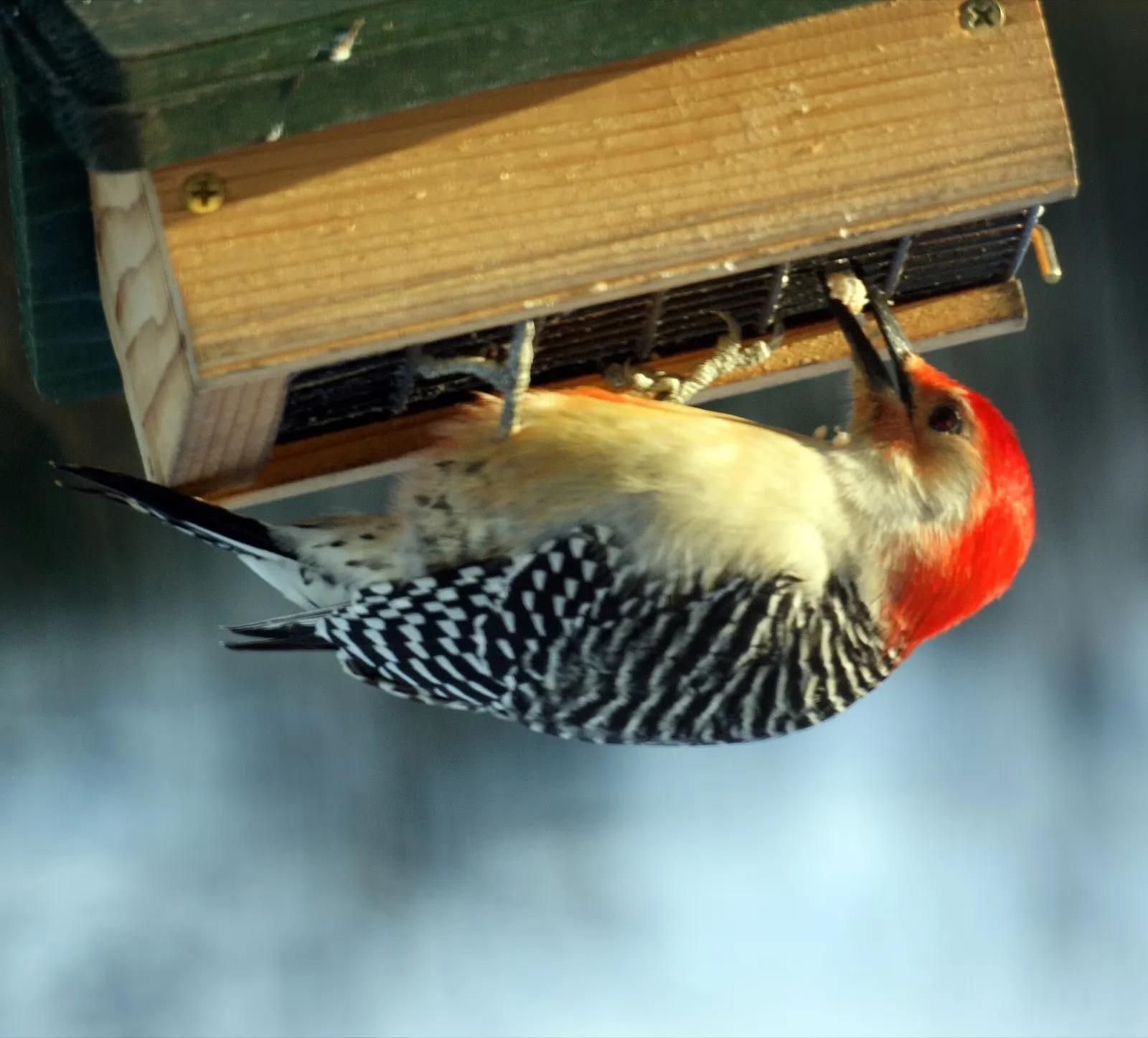 Red-bellied woodpecker hanging under a wooden suet feeder in winter
Photo: Mike's Birds, Wikimedia Commons, CC BY-SA 2.0
If the damage is serious and you are still unsure how to get rid of woodpeckers legally, contact your local Fish and Wildlife Service migratory bird program, where wildlife professionals will help you assess the situation and find legal solutions. For other yard mysteries, our animal guide handles identification, and the humane removal guides cover exclusion work for each species.
FAQ#
Are woodpeckers protected in the United States? Yes. Almost all native birds, including their nests and eggs, are protected under the Migratory Bird Treaty Act, and the Fish and Wildlife Service confirms that woodpeckers are among the more than a thousand protected species.
Can I remove a woodpecker nest from my siding? Not while it is active. If eggs or young are present, control measures wait until the young leave permanently, usually around midsummer.
Why is it pecking metal instead of wood? Because it is drumming, not feeding. Metal gutters, downspouts, chimney caps, and vents resonate better than siding does.
How to get rid of woodpeckers on a wooden house? Start with netting over the damaged side, and close any insect infestation under the siding. Cedar and redwood take the most damage, so those are the surfaces to check first.
Does a fake owl keep woodpeckers away? No. Owl, hawk, and snake models are ineffective. Moving, reflective objects such as spinners and mylar strips have a better but still inconsistent record.
Sources#
- U.S. Fish & Wildlife Service. Migratory Bird Treaty Act of 1918. Accessed 17 November 2026.
- U.S. Fish & Wildlife Service. Woodpeckers and your home. Accessed 17 November 2026.
- University of California Statewide IPM Program. Woodpeckers (Pest Notes, UC ANR Publication 74124). Accessed 17 November 2026.
- Cornell Lab of Ornithology, All About Birds. Pileated Woodpecker. Accessed 17 November 2026.
You made it to the end!
Still not sure who visited? Bobr's sign finder narrows it down in a few taps.
Keep reading
Skunk Smell Removal: What Actually Works
Skunk smell removal that works: the peroxide, baking soda and dish soap mix neutralizes the spray.
Moles in Yard: Signs, Damage and How to Stop Them
Moles in yard soil leave volcano mounds and raised ridges.
Do Opossums Carry Rabies? What the Evidence Says
Do opossums carry rabies? Rarely, and the animals are not immune.
No comments yet. Seen this in your own yard? Start the thread.
Leave a comment